Bacteriostatic Water, Explained
A concise overview of bacteriostatic water, its benzyl alcohol preservative, and its role in sterile peptide reconstitution for laboratory research.
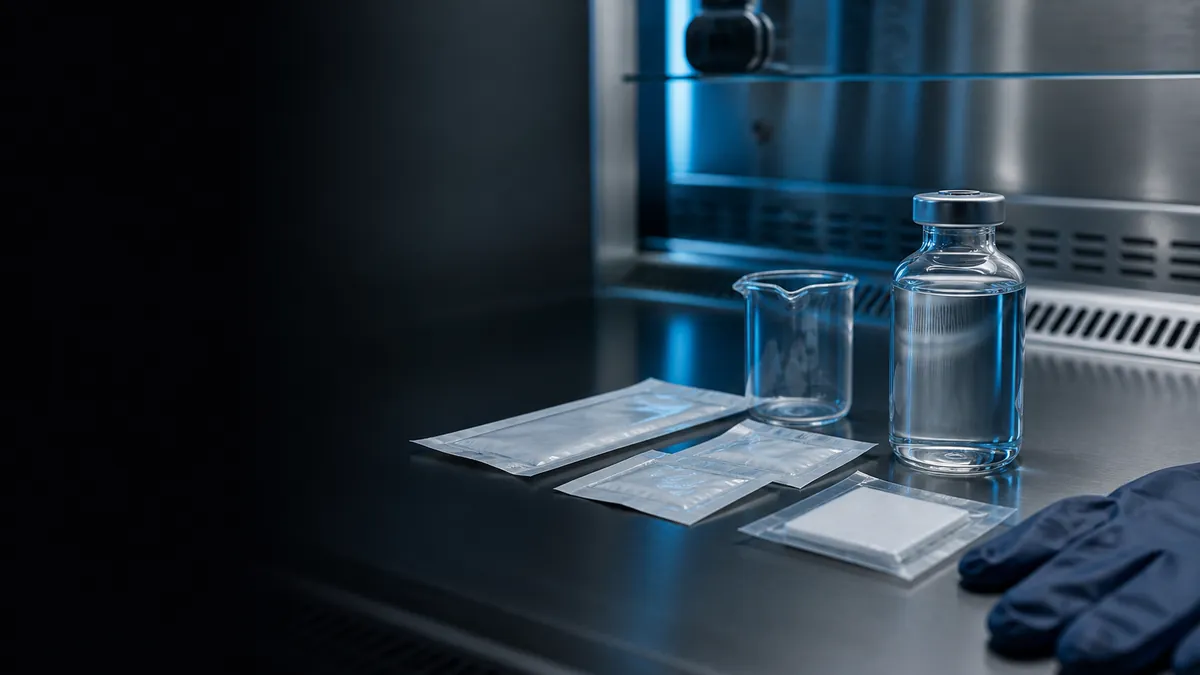
Bacteriostatic water is one of the most consistently used aqueous solutions in peptide research workflows. Its defining characteristic is the inclusion of a low concentration of benzyl alcohol (typically 0.9% w/v), a preservative that inhibits the proliferation of bacteria and other microorganisms after the container has been opened. This makes it fundamentally different from plain sterile water for injection, which is intended strictly for single-use applications and offers no microbial protection once the seal is broken.
What Sets Bacteriostatic Water Apart
Standard sterile water carries no preservative agent. Once opened, any microbial contaminants introduced during handling can multiply unchecked, making the solution unsuitable for repeated access. Bacteriostatic water solves this limitation by maintaining an environment that suppresses bacterial growth across multiple draw events, provided good aseptic technique is observed throughout.
The preservative action of benzyl alcohol is well characterized in the scientific literature. At the concentrations used in bacteriostatic preparations, it disrupts bacterial cell membranes and impairs enzymatic function, effectively halting replication without sterilizing the solution outright. This distinction matters in a laboratory context: the solution remains bacteriostatic (growth-inhibiting) rather than bactericidal (kill-all), which is sufficient for the multi-use vial applications common in research settings.
Role in Peptide Reconstitution
Lyophilized (freeze-dried) peptides are routinely supplied as a dry powder or cake within sealed vials. Before these compounds can be studied in laboratory models, they must be brought into solution, a process known as reconstitution. Bacteriostatic water is a widely accepted diluent for this step because it combines two practical properties: it is aqueous and compatible with the polar chemistry of most peptide structures, and it allows the resulting solution to be accessed more than once without introducing unnecessary contamination risk between uses.
In research practice, a prepared peptide solution may need to be aliquoted or sampled at intervals over several days. Using a diluent that preserves sterility across those repeated needle insertions reduces one variable in an otherwise tightly controlled experimental environment.
Benzyl Alcohol: Concentration and Compatibility
The 0.9% benzyl alcohol concentration found in most bacteriostatic water formulations is the established standard for multi-dose parenteral diluents and has been studied extensively for compatibility with a broad range of peptide and protein compounds. Researchers working with sensitive biologics should verify compatibility on a compound-by-compound basis, as certain peptide sequences or formulations may interact with organic preservatives in ways that affect stability or solubility.
When compatibility data is uncertain, some research protocols call for plain sterile water or an alternative diluent, with the trade-off of limiting the prepared solution to a single-use timeframe. The choice of diluent should always be guided by the specific requirements of the compound being studied and the conditions outlined in the relevant research protocol.
Sterile Reconstitution Technique
The integrity of a reconstituted peptide solution depends as much on handling technique as on the quality of the diluent itself. Key practices observed in well-run laboratory settings include:
- Using a new, sterile syringe and needle for each draw from the bacteriostatic water vial, and for each injection into the peptide vial. Reusing needles introduces particulate matter and increases contamination risk.
- Swabbing vial septa with an appropriate disinfecting agent prior to needle insertion, and allowing adequate contact time before proceeding.
- Adding diluent slowly along the interior wall of the peptide vial rather than directing the stream forcefully at the lyophilized material, which can mechanically degrade delicate peptide structures.
- Gently rolling or swirling the vial to mix, rather than shaking, in order to minimize shear-induced aggregation.
- Inspecting the resulting solution for clarity and absence of particulates before use, and discarding any preparation that appears cloudy, discoloured, or contains visible matter.
Storage of Bacteriostatic Water
Unopened bacteriostatic water vials should be stored according to the manufacturer's stated conditions, generally at controlled room temperature away from direct light and heat sources. Once opened, the vial should be stored appropriately (typically refrigerated, unless the manufacturer specifies otherwise) and used within the recommended window, commonly 28 days, after which the preservative efficacy and overall sterility assurance diminish. Date-labelling opened vials is standard practice in any rigorous research environment.
Reconstituted peptide solutions have their own stability profiles independent of the diluent. Researchers should consult compound-specific stability data and store prepared solutions under conditions (temperature, light exposure, duration) consistent with those guidelines.
Laboratory Applications
Bacteriostatic water is used across a broad spectrum of laboratory disciplines wherever lyophilized compounds require aqueous reconstitution and multi-access vials are part of the workflow. In peptide research specifically, its use spans in vitro cell-based assays, biochemical binding studies, and various preclinical research models where consistent, sterile preparation of compounds is a baseline requirement for reproducible results.
The value of a reliable diluent in these contexts should not be underestimated. Variability introduced at the reconstitution stage can propagate through an entire experimental series, complicating data interpretation. Selecting a well-characterized, preservative-containing diluent like bacteriostatic water is one straightforward way to reduce that source of variability.
For research use only. Not for human consumption.
Research-grade peptides, documented.
99%+ purity, third-party Certificate of Analysis with every batch, discreet domestic shipping.
Browse Products