How to Store Research Peptides
A practical overview of temperature, humidity, light, and sterility controls that help preserve lyophilized peptide integrity throughout laboratory research.
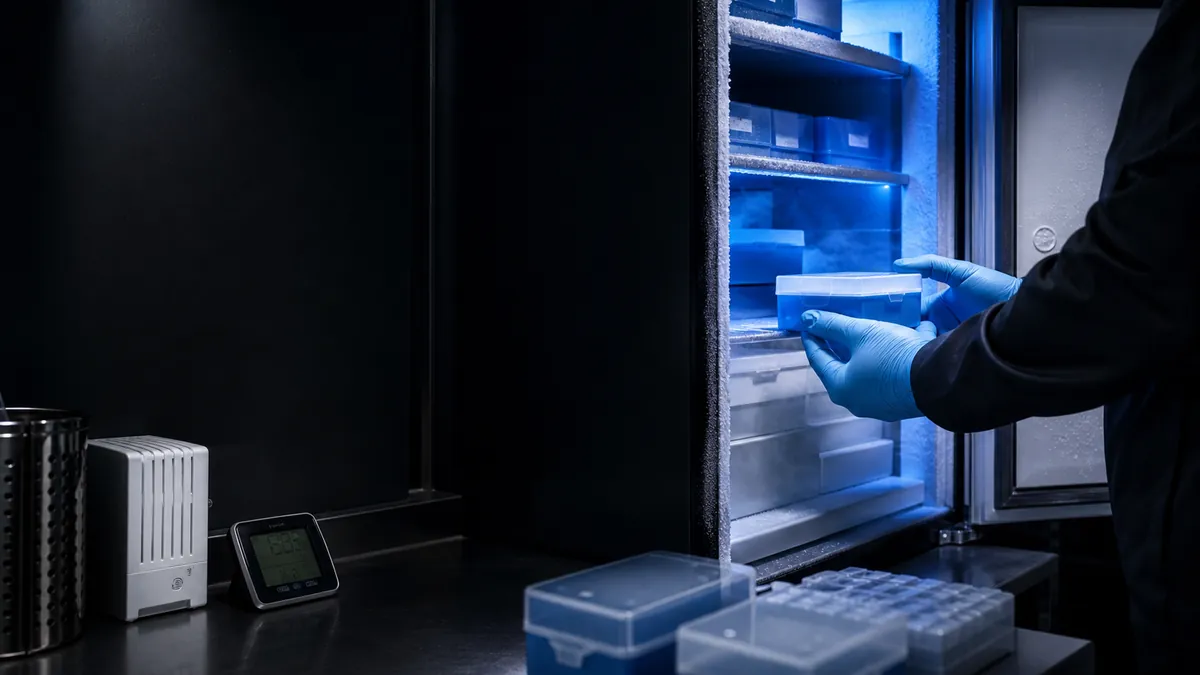
Correct storage conditions are a foundational requirement for reliable peptide research. Lyophilized (freeze-dried) peptides are chemically stable in powder form, yet they remain vulnerable to environmental stressors including heat, moisture, light, and repeated temperature cycling. Understanding how each of these factors affects compound integrity allows laboratory personnel to implement controls that protect sample quality over the full duration of a study.
Temperature and Refrigeration
Lyophilized peptides are routinely stored at either refrigerator temperature (2°C to 8°C) for short-to-medium-term use, or at -20°C for extended archival storage. In general, colder and more stable conditions translate to slower degradation kinetics. Peptides that contain oxidation-prone residues (such as methionine or cysteine) or that are particularly susceptible to hydrolysis benefit most from sub-zero storage.
Regardless of the chosen temperature range, the key principle is consistency. Brief excursions above the target temperature, even those lasting only a few hours, can meaningfully accelerate peptide degradation, particularly once a vial has been opened or reconstituted.
Controlling Humidity and Moisture Exposure
Moisture is among the most damaging environmental factors for lyophilized peptides. Water molecules can disrupt peptide bonds and promote aggregation, both of which reduce compound purity and research reliability. To minimize this risk:
- Keep vials sealed until the point of use. Lyophilized peptides are typically supplied under inert gas or vacuum; breaking that seal should be done only when the sample is needed.
- Allow cold vials to equilibrate to room temperature before opening. This prevents condensation from forming on the interior walls of the vial and contaminating the powder.
- Store opened or reconstituted samples in airtight containers. Desiccant packs placed inside storage boxes provide an additional buffer against ambient humidity in the laboratory environment.
Protection from Light
Ultraviolet and visible light can drive photodegradation in certain peptide residues, particularly those containing aromatic side chains such as tryptophan and tyrosine, as well as disulfide bonds. Storing peptides in amber vials or opaque containers, and keeping storage units away from windows or UV-emitting laboratory fixtures, reduces this exposure. Even brief periods under strong artificial lighting during sample preparation can be minimized by working efficiently and returning vials to covered storage promptly.
Minimizing Freeze-Thaw Cycles
Each cycle of freezing and thawing introduces mechanical stress to peptide solutions. Ice crystal formation during freezing can physically disrupt peptide structure, while the concentration effects that occur during partial thawing can promote aggregation. Best practice is to aliquot reconstituted peptide stock into single-use volumes before freezing. This way each aliquot is thawed only once, eliminating repeated cycling and preserving the integrity of the remaining stock.
For lyophilized (unreconstituted) material, freeze-thaw cycling is less damaging but still worth avoiding. Repeatedly warming a sealed vial and returning it to a freezer stresses the vial closure and increases the cumulative risk of moisture ingress.
Sterile Technique During Reconstitution
Reconstitution introduces liquid into the vial and, with it, the potential for microbial or chemical contamination. Sterile practice during this step is non-negotiable in a research context. Recommended controls include:
- Use sterile, bacteriostatic, or otherwise appropriate reconstitution solvent and verify its compatibility with the specific peptide sequence before use.
- Clean bench surfaces and use a laminar flow hood or biosafety cabinet where available.
- Swab vial septa with 70% isopropyl alcohol and allow to dry before needle insertion.
- Use sterile, single-use syringes and needles. Do not re-use or re-sterilize disposable equipment.
- Label reconstituted vials with the date of preparation and store according to the solvent and peptide manufacturer guidance, typically at 4°C with a defined use-by window.
General Handling Principles
Beyond the specific controls outlined above, a few general principles support consistent peptide quality across all storage and handling steps:
- Minimize the time any vial spends outside its target storage environment. Retrieve only what is needed for the current experiment and return remaining material promptly.
- Record storage conditions, including any deviations, in laboratory notebooks or electronic records. This supports data integrity and makes it easier to correlate any observed changes in compound behavior with specific handling events.
- Inspect vials before use. Visible particulates, unusual coloration, or cloudiness in a reconstituted solution may indicate degradation or contamination and warrant investigation before proceeding.
Summary
Maintaining peptide integrity in a research setting requires consistent attention to temperature, humidity, light exposure, freeze-thaw cycles, and sterile technique. Implementing these controls as standard operating procedure supports reproducible results and extends the usable lifetime of laboratory compounds.
For research use only. Not for human consumption.
Research-grade peptides, documented.
99%+ purity, third-party Certificate of Analysis with every batch, discreet domestic shipping.
Browse Products